Inspiring Life-long Learning for Over 25 Years


Most of us give little thought to the origins of the things we use every day. A wool sweater begins on a sheep’s back; the colors in its yarn may begin in a garden or beneath a walnut tree. Between those beginnings and the finished garment lies a remarkable history of discovery, ingenuity, and human effort. In third-grade Handwork at Da Vinci Waldorf School, children are tracing that journey for themselves, learning how human hands transform natural materials through knowledge, skill, and patient work. In the process, they’re beginning to recognize something equally remarkable: the possibilities within themselves.
Recently, our third graders rolled up their sleeves and got to work washing raw sheep’s fleece, an early step in the process of transforming wool into yarn. Fresh fleece contains lanolin, dirt, and bits of vegetation, all of which must be carefully washed away before the wool can be carded and spun. The children handled the fibers gently, learning how easily too much agitation can turn loose wool into a tangled mass of felt. Through this hands-on work, they encountered a material with its own particular properties and began to understand the knowledge, care, and effort involved in preparing it for use.
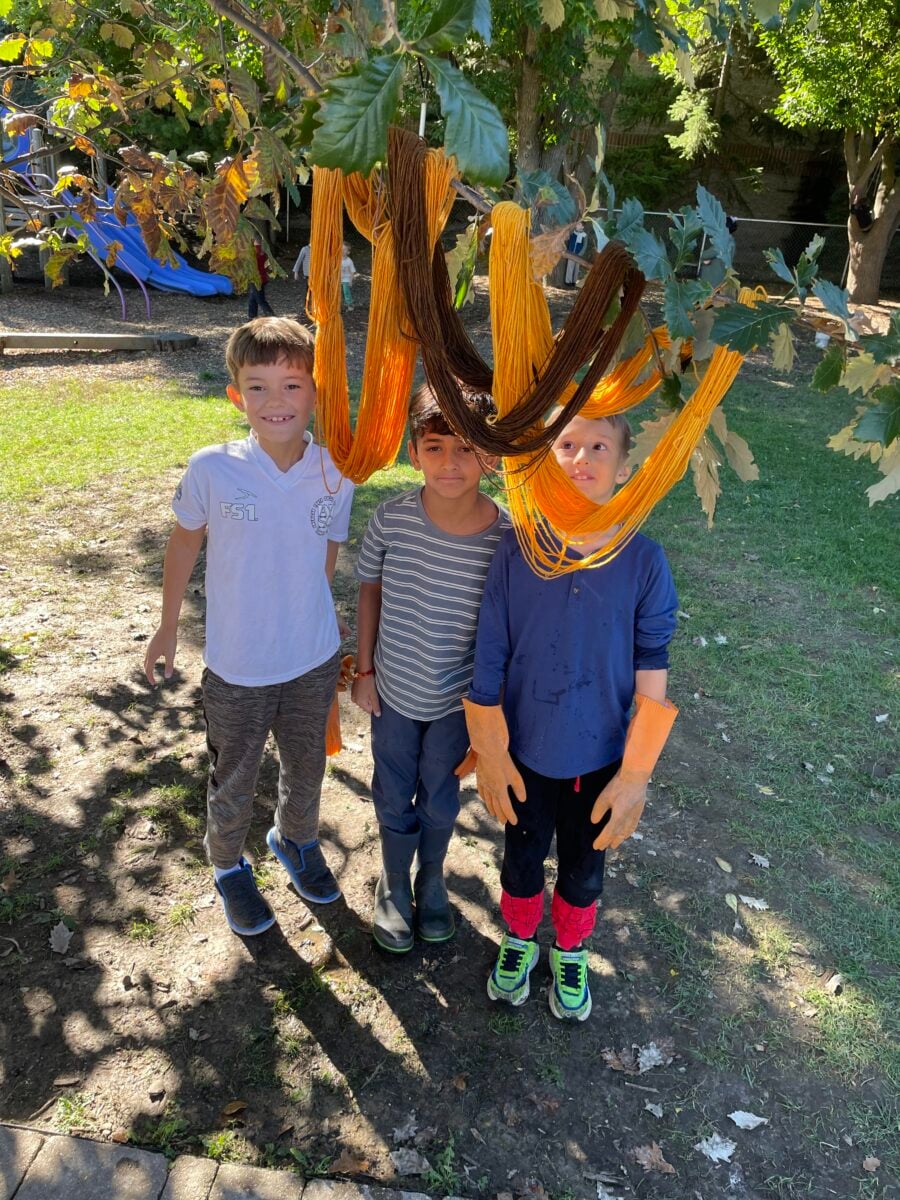
Having begun their journey with the wool itself, the third graders turned their attention to another essential element of textile making: color. From the school’s carefully tended dye gardens, Dyer’s Coreopsis and Yellow Cosmos offered more than their cheerful blossoms; they held the rich golden pigments that would transform the wool. The flowers had been cultivated, harvested, and dried in preparation for this work. Black walnuts were locally foraged to provide a palette of rich, earthy browns. Working with these natural materials, the children prepared their yarn for solar dyeing, which allows the sun to gradually warm the dye baths and release the plants’ colors into the fibers. When the children rinsed the skeins, they revealed a remarkable transformation: the yarn had taken on a beautiful array of golds and browns. Mrs. Griffith summed up the experience with three wonderfully honest words: “Stinky but fun!”
In the process of turning fleece and flowers into colorful yarn, the children engage with science, history, and art without any clear boundary between them. They explore the science of natural fibers and plant pigments, encounter textile-making traditions handed down through generations, and discover an artist’s palette growing right outside their classroom. Each discovery enriches the others, giving the children a more complete understanding of the work and its place in the world. This is one of the remarkable strengths of Waldorf education: subjects that might otherwise seem unrelated become interconnected parts of a single, meaningful experience.
Every stage of this work calls for something beyond knowing how to do it. Washing fleece requires care and attention; preparing fibers demands patience; learning to work with yarn brings repetition, practice, and the inevitable frustrations of mastering a new skill. Each challenge invites the children to move beyond what comes easily and discover what becomes possible through their own efforts. This is central to a foundational principle woven throughout Waldorf education: cultivating the will—the inner capacity to act with intention, persevere through difficulty, and carry an undertaking to completion. Through meaningful, purposeful work, children gradually develop not only the skills to accomplish a task, but the confidence and determination to approach new challenges, explore unfamiliar possibilities, and bring their own ideas to life.
“Each challenge invites the children to move beyond what comes easily and discover what becomes possible through their own efforts.”
There is a particular developmental reason why this work holds such significance in third grade. Around the age of nine, children begin to experience a growing awareness of themselves as individuals, separate from the world around them. This important transition, known in Waldorf education as the nine-year change, often brings new questions about independence, belonging, and their own place in the world. Our third-grade curriculum is thoughtfully designed to meet children at this particular stage, with an emphasis on the practical foundations of human life. Through farming, gardening, building, food preparation, and traditional crafts, third graders explore how human beings provide for their fundamental needs of food, clothing, and shelter. As they learn to grow, build, prepare, and create things with their own hands, they gain something especially valuable at this age: a growing sense of security in their world and confidence in their ability to find their way within it.
The next time these children pick up a ball of yarn or pull on a wool sweater, they may see something that wasn’t apparent to them before: the natural resources, human ingenuity, and generations of knowledge behind an ordinary object. Perhaps the more lasting discovery is what they have begun to recognize in themselves. What starts with learning to wash fleece or work with unfamiliar materials becomes an experience of approaching a challenge, acquiring new skills, working through difficulties, and discovering what their own efforts make possible. These are capacities that reach far beyond the handwork classroom, laying the groundwork for a lifetime of learning, creativity, and independent thought. Whether the path ahead leads to art, science, practical endeavors, or possibilities not yet imagined, children carry with them something more valuable than any finished project: a growing understanding that they can meet the unknown, learn what they need to know, and help shape what comes next.